Code-Less is the WCS platform you run Physical AI with — build and change robot workflows on a visual canvas, no developer required. It is the layer where the loop learns: orchestrate up to 500 devices in milliseconds, then connect the system to your operation.
0:20
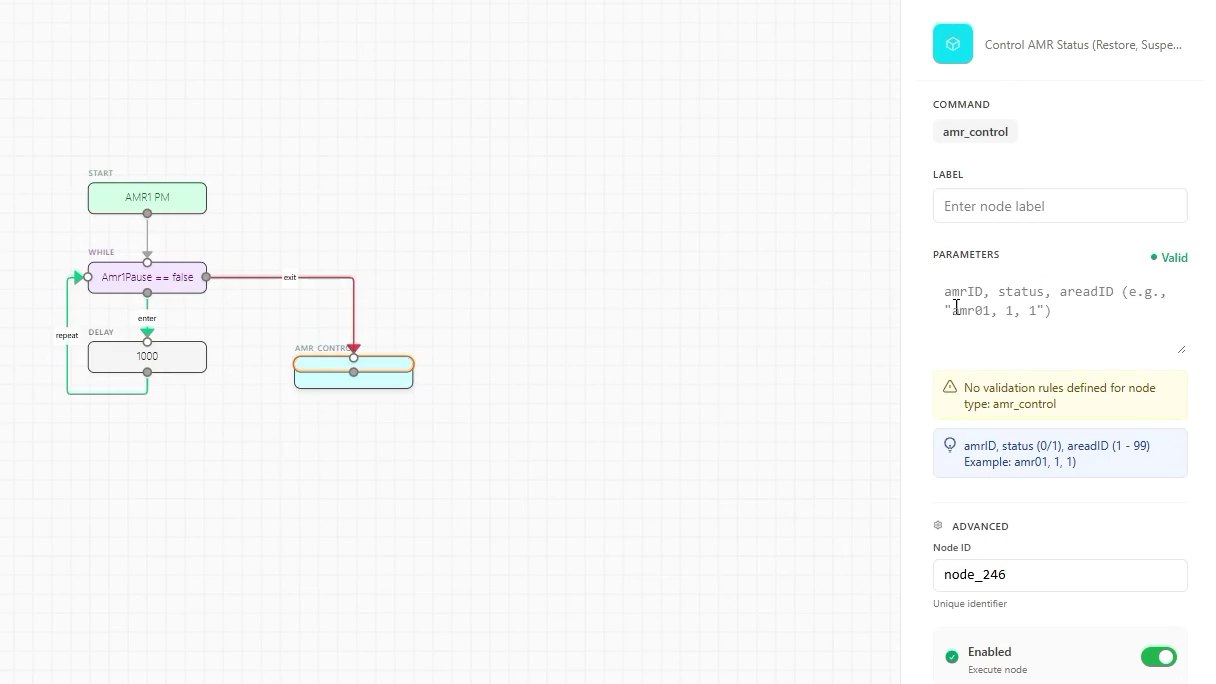
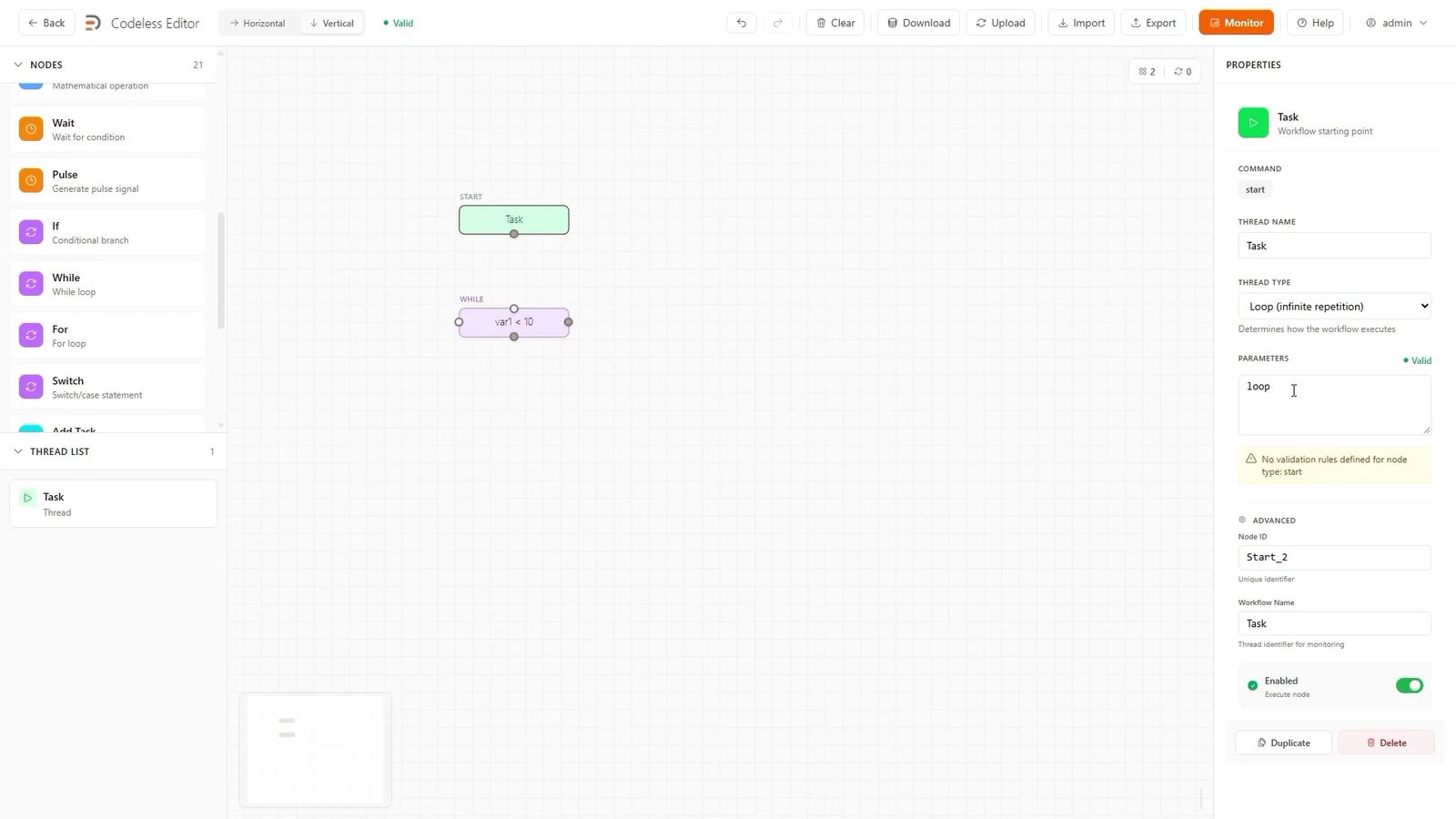
Change the loop. A decision node is dropped into a running branch and the canvas rewires itself — the loop gains a repeat path and an exit, validated in place. No code, no rebuild.
0:20
Start empty. The canvas before the first node, and the moment it stops being empty.
0:20
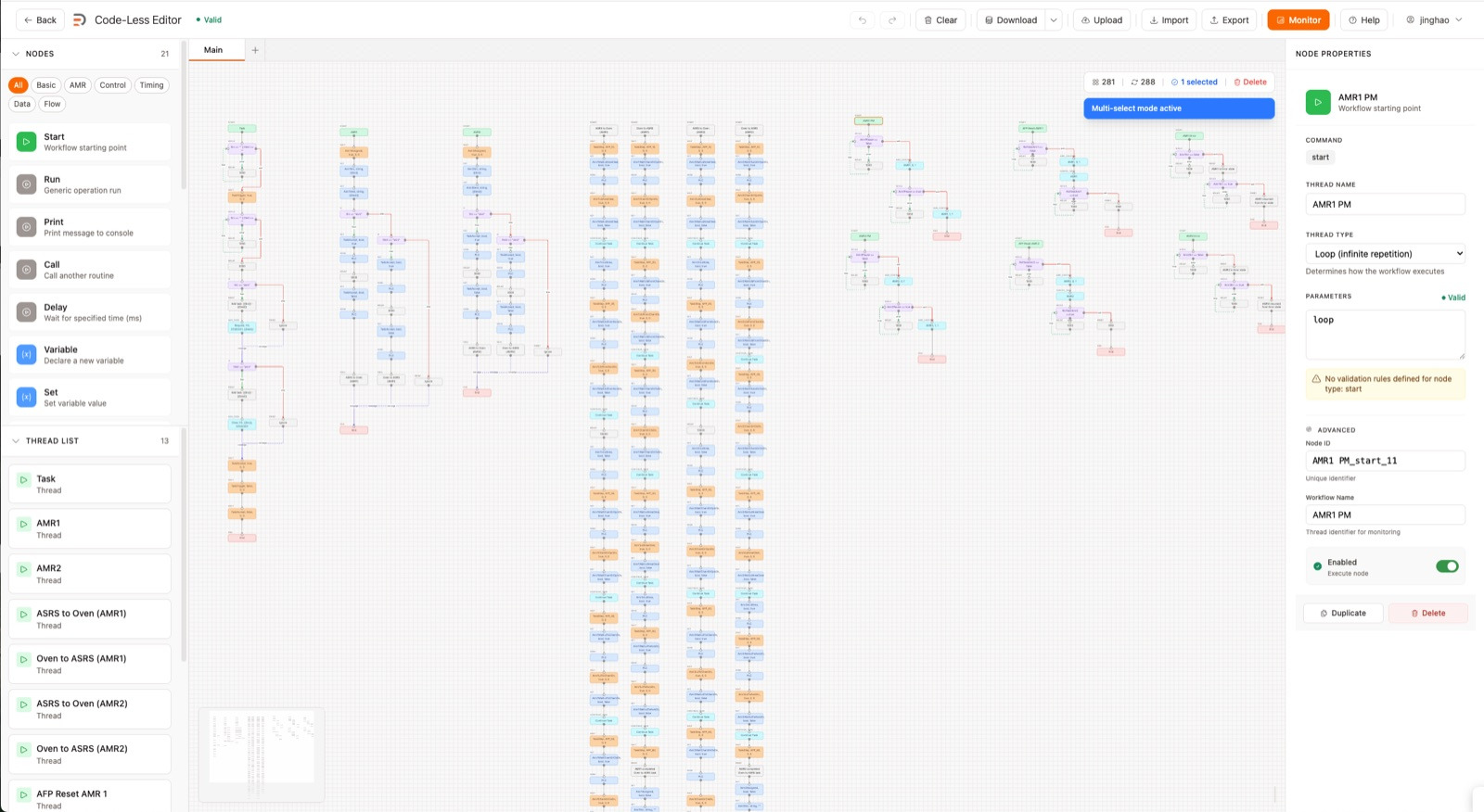
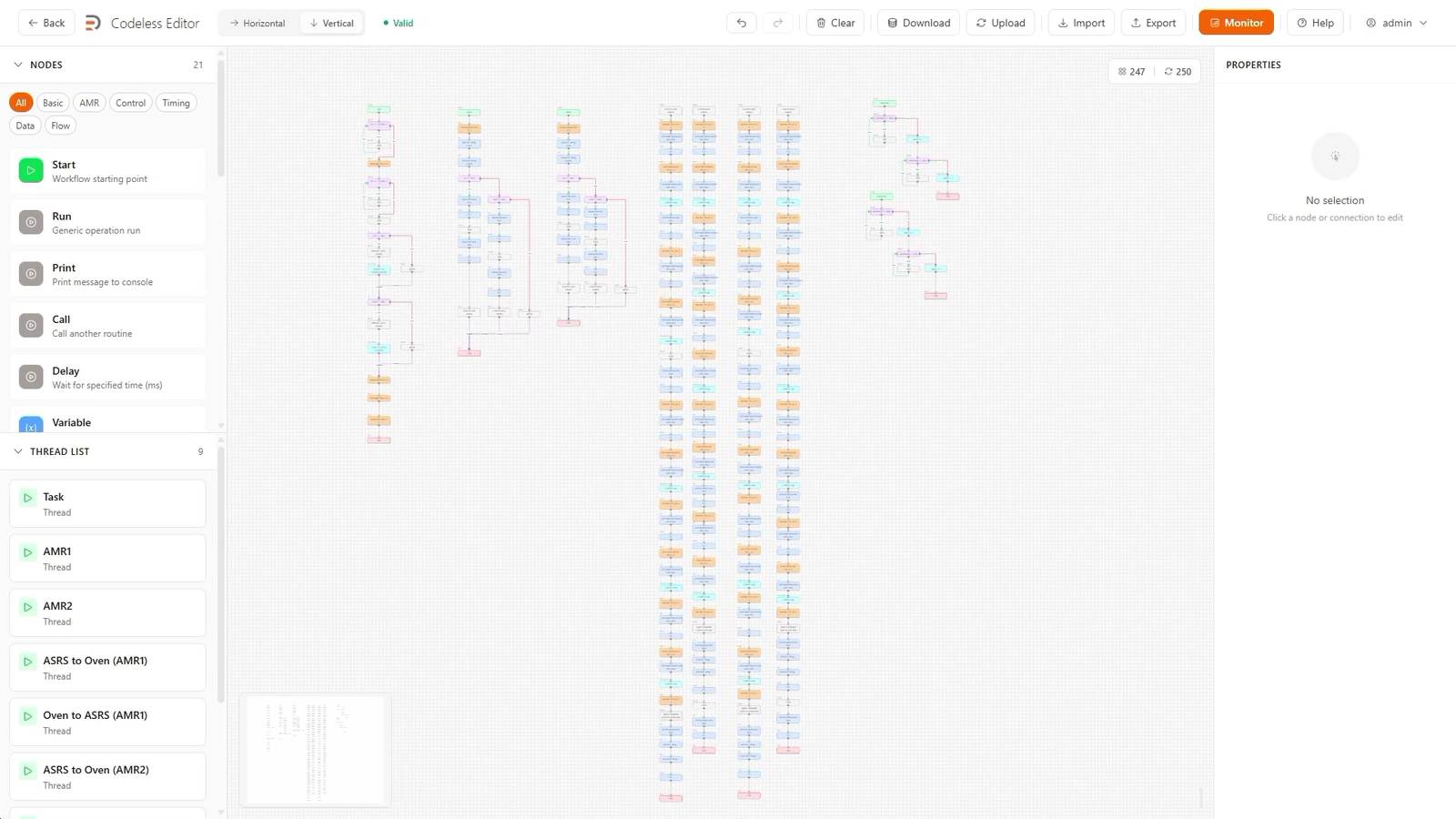
Then scale. The camera pulls back from a handful of nodes to a 247-node workflow running three threads at once.
Code-Less is the WCS platform that runs your Physical AI. It replaces coding with a visual, node-based canvas — so changing a workflow takes minutes, not days, and the people who know the process best can do it themselves.
Change your workflow in minutes, not days. No developer queue. No downtime. Just drag, connect, and run.
A web-based workflow design environment. Connect nodes to build process and robot logic, configure parameters, and validate before it runs — all from one canvas.

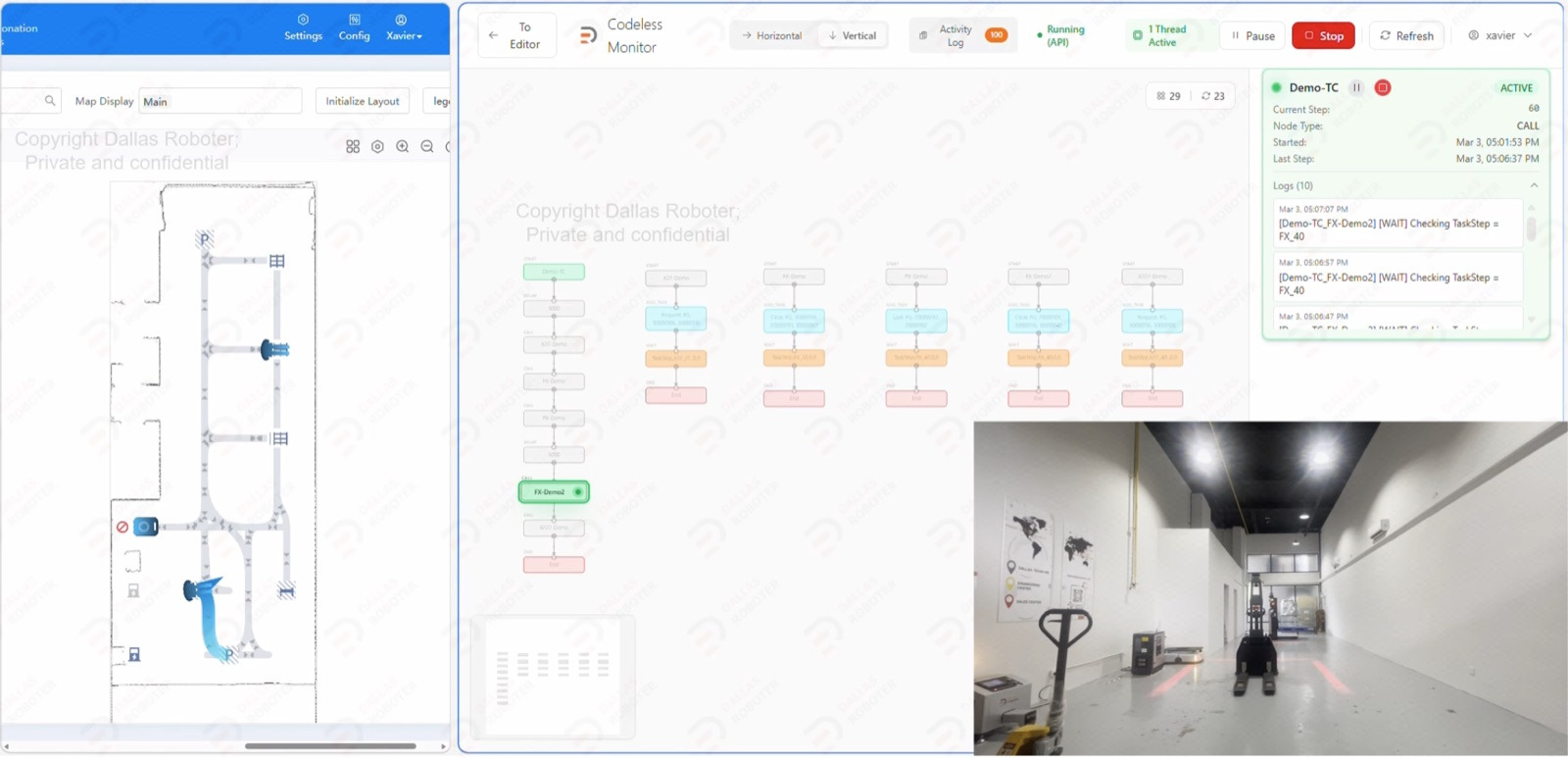
See every thread execute as it happens, then pause, step, or override at the node — without stopping the rest of the fleet.

Pull nodes from Basic Operations, Data, Control Flow, Timing, and AMR Operations onto the canvas.
Link node outputs to inputs to define exactly how the logic should flow.
Validate, then execute and monitor live — start, pause, or stop a workflow at any time.
Change process logic yourself — iteration no longer routes through a dev backlog or waits on scarce developer time.
Change It YourselfA live indicator confirms the workflow is valid before it runs, catching broken logic before it ever reaches production.
Fewer ErrorsProcess logic and AMR operations in a single environment — from the canvas to the fleet.
Built-In FlexibilityCode-Less is the WCS platform you run Physical AI with. Beneath it, the RCS schedules the fleet in milliseconds and the Task Manager connects your operation to the robots — one platform, all the way down.
The no-code platform you run Physical AI with. Design and change robot and process logic by connecting visual nodes — no developer queue, no code required.
The scheduling and orchestration engine. Millisecond path planning, multi-vehicle traffic management, and task allocation across your whole fleet.
The bridge to your operation. A web interface to assign tasks, monitor progress, and integrate with containers, callboxes, and your WMS/ERP.
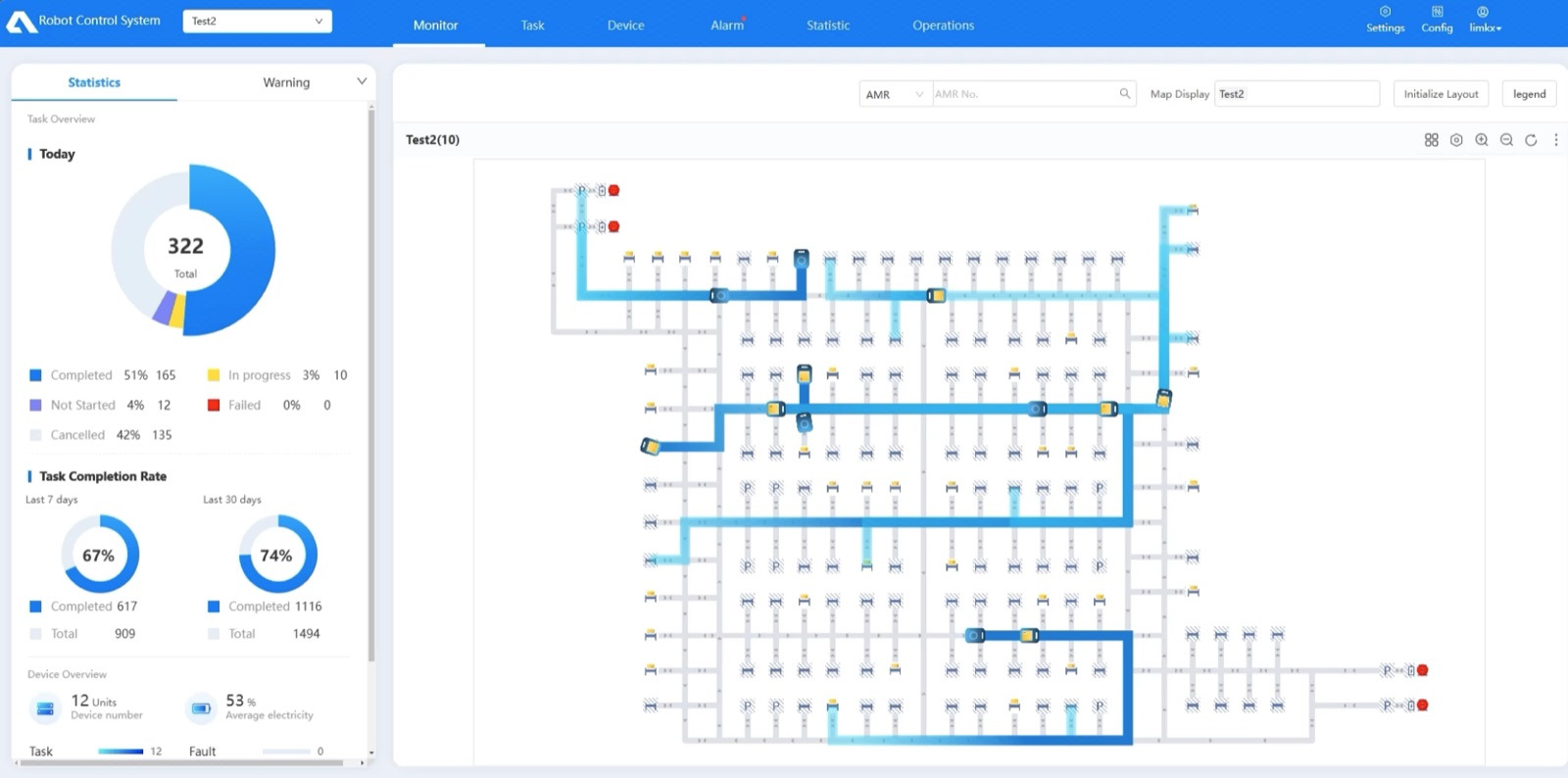
The RCS is the Robot Control System — the single interface to set up, schedule, and orchestrate your fleet. Import the SLAM map, add devices and charging stations, configure tasks, and monitor alarms and throughput in real time.
Import the LiDAR SLAM map. Add AMR devices and charging-station models — multiple models coexist on one map. Access remotely by IP from anywhere on your network.
Live Status DashboardConfigure tasks with templates, define the target point, and assign a specific vehicle. Select task targets directly on the RCS map for clear visualization.
Map-Based TargetingMonitor AMR alarms in real time, with detailed diagnostics and a complete alarm history log for analysis, troubleshooting, and performance tracking.
Remote SupervisionTask throughput and server performance visualized as intuitive graphs — enabling data-driven decisions and continuous optimization at scale.
Data-Driven OpsRoutes are planned with motion models, aisle width, point rotation, and orientation constraints, so two vehicles do not claim the same space at the same time — compatible with mixed vehicle types in one fleet.
Multi-vehicle collision detection based on the Separating Axis Theorem, plus traffic prediction and autonomous obstacle avoidance.
Region-specific traffic control with right-of-way priority, early avoidance, abnormal-obstacle bypass, and cold/hot zone automatic diversion.
Dynamic allocation adapting to multiple constraints, with segmented-path dispatch and right-of-way control beyond fixed nodes.

The Task Manager is how your team actually works with the system — assigning tasks, tracking progress, managing containers, and integrating with your facility's own signals.
Process task commands from the UI to the RCS and collect task, robot, alarm, and shelf data for sharing between modules.
Command & Data HubManage container data (table, rack, pallet) from the RCS and make selection or placement decisions based on task commands.
Container IntelligenceAn overview of production — overall task progression, output count, and date filters — on a web interface accessible from any device on your network.
Production OverviewSelf-developed hardware to retrieve client-side signals via IO, PLC, MQTT, or Modbus, processed into task commands and flow logic.
Signal IntegrationFrom your business systems to the robots on the floor, the software is built as a layered stack — each layer plugging into the next.

Up to 500 devices per server, with multi-server cluster support — 300 AMRs processing 25,000 tasks per hour, in a single operation.
300 AMRs processing at scale, in a single operation.
Millisecond-level planning for individual AMRs.
From assessment to operational — with the software included.
Request a live walkthrough of Code-Less and the RCS with our engineering team.
← See how the material moves itself on your floor
askme@dallasroboter.com · DFW, Texas · Engineering: Cyberjaya, Malaysia